
Overview
On behalf of Google, the Bonneville Environmental Foundation’s Business for Water Stewardship program invites Expressions of Interest (EOI) for projects that seek to address critical water challenges in the Netherlands.
Expressions of Interest will be accepted for feasibility, pilot, or implementation projects focused on water stewardship in the areas of water infrastructure, agriculture, and nature.
After submitted EOIs are reviewed, a subset of applicants will be invited to submit a full Technical Proposal for consideration of financial support.
Google’s Water Replenishment Goal
In 2021, Google announced its goal to replenish more water than it consumes, on average, across its data centers and offices by 2030. To achieve this, Google supports water stewardship projects and initiatives, with the intent to help address water challenges in the communities where it operates. In the Netherlands, Google operates in Eemshaven (Eems basin) and Agriport/Hollands Kroon (Rijn basin).
To track progress towards its water replenishment goals, Google follows the guidance outlined in the Volumetric Water Benefit Accounting (VWBA) 2.0 methodology to quantify the benefits of the projects it supports (measured in water volumes). More details about this framework is provided below.
The Bonneville Environmental Foundation
The Bonneville Environmental Foundation (BEF) is a US-based nonprofit organization that focuses on advancing climate solutions by partnering to create innovative, measurable, and scalable solutions for water stewardship and renewable energy transition. Founded in 1998, this operates at the intersection of business, environment and community – bringing together partners across all sectors of society to co-create solutions that restore freshwater ecosystems and catalyze a renewable energy future for all.
BEF’s Business for Water Stewardship (BWS) program helps private businesses collaborate with communities, policy stakeholders, and conservation partners to implement solutions that ensure sufficient, clean water for people, economies, and ecosystems. It promotes “water stewardship” by helping companies to balance their water footprint by investing in actions that address water challenges where they have operations.
What is the Aspiration?
The Netherlands faces a growing set of water challenges that call for near-term place-based solutions. The institutions and businesses of the Dutch water sector have deep experience and expertise in addressing these challenges and have been actively developing approaches that can be further explored, implemented, and scaled. This program seeks to support this work with the goal of carrying promising ideas from concept to reality – and building the relationships needed to carry them out at scale.
What are the Water Challenges?
Proposed projects should seek to address one or more identified water challenges affecting water users and stakeholders, including the general public (safety and well-being), economic systems (businesses and the products or services they provide), and ecosystems. The following are some examples of relevant shared water challenges:
- Change in precipitation leading to prolonged summer droughts and an increase in the severity and frequency of precipitation events in the winter
- Freshwater availability
- Saltwater intrusion in coastal and low-lying polders due to rising sea levels
- Increased flood risk from riverine and soil saturation (due to changes in precipitation patterns) and sea level rise
- Land subsidence from peat oxidation
- Surface and groundwater quality
- Biodiversity and ecosystem function loss
- Water availability for reuse through off-grid solutions
Opportunity
This program is designed to invest in local expertise to support activities along the entire continuum of development – from early state feasibility and pilot testing to shovel-ready implementation, with the goal of creating lasting improvements to water resilience in the Rijn and Eems basins.
Please review the following drop-down sections below, to evaluate the project category types for your submission.
Funding range: up to €100,000 (including VAT if required)
Number of projects: up to 3
Feasibility projects support the development of innovative solutions expected to lead to future pilot or implementation projects. They are intended to explore new or emerging concepts, catalyze project success, or mitigate barriers to progress. For example, completing a feasibility study, preliminary design, or to confirm the viability and estimate project impacts before committing to full-scale implementation. General examples include:
- Hydrological and hydrogeological studies to assess a new approach or technology
- Feasibility assessments to determine technical, economic, or social feasibility of a new concept or idea
- Stakeholder engagement, co-design, or governance development processes that are needed to secure the landowner, agricultural, or municipal agreements necessary for implementation
- Development of a monitoring and measurement framework, including the installation of baseline instrumentation
To be considered for feasibility project support, proposals should satisfy the following conditions:
- Clear pathway to action: the proposal must describe a specific, credible pilot or implementation project that the feasibility activity is intended to unlock, including a conceptual pathway to volumetric water benefits that would be defined in a full technical proposal if invited to develop one.
- Timescale: the feasibility study must be complete by the end of 2030, with a credible plan for the downstream pilot or implementation project to begin construction no later than 2035.
- Proportionality: the cost of the feasibility project must be proportionate to the scale and anticipated water benefit of the downstream pilot or implementation project. BEF will not fund standalone research without a clear pathway to on-the-ground action.
Funding range: up to €300,000 (including VAT if required)
Number of projects: up to 3
Pilot projects are on-the ground actions designed to test a new concept or innovation – often called proof-of-concept projects. Pilot projects may follow the successful completion of a feasibility study and are likely to include rigorous data collection and analysis to evaluate the project’s effectiveness and inform the potential for expanding the project or technique to scale. Pilot projects should describe how the knowledge gained is expected to lead to expansion of the action or intervention at scale. General examples include:
- Small-scale peatland rewetting to assess water retention and ecological response
- Testing of automated or AI-managed water control structures to optimize delivery for agricultural or ecological needs
- Innovative applications of closed-cycle water reuse at the community scale.
To be considered for pilot project support, proposals should satisfy the following conditions:
- Clear pathway to action: the proposal must describe a specific, credible implementation project that the pilot project is intended to lead to. If possible include a preliminary estimate of the volumetric water benefits.
- Timescale: the pilot project must be complete by the end of 2030, with a credible plan for the downstream implementation project to begin construction no later than 2035.
- Proportionality: the cost of the pilot project must be proportionate to the scale and anticipated water benefit of the downstream implementation project. BEF will not fund standalone pilot projects without a clear pathway to on-the-ground action.
Funding range: €300,000 and up (including VAT if required)
Number of projects: up to 3
Implementation Projects are shovel-ready projects that will be operational before 2030. Any project that conserves, restores, or retains water in the watershed and that addresses a shared water-related challenge may qualify as an implementation project. Implementation projects will be evaluated on the basis of potential volumetric water benefits following the Volumetric Water Benefit Accounting (VWBA) 2.0 guidance and on their relevance to local challenges and values.
To be considered for pilot project support, proposals should satisfy the following conditions:
- Shovel-readiness: the project must have a clear, near-term construction or implementation timeline and must be operational by 2030
- Volumetric water benefit: projects must demonstrate a credible pathway to quantifiable volumetric water benefits as outlined in the VWBA 2.0 framework. A preliminary estimate of expected annual water benefit is required at the EOI stage.
- Durability: the project must deliver measurable benefits for a minimum of five years following its completion
Google’s intention is to claim proportional volumetric water benefits based on its share of the total project cost. Project implementers are expected to operate and maintain the project as agreed and to provide brief annual reports confirming the project’s status and documented benefits.
Requested funding may cover upfront capital expenditure, operations and maintenance, annual reporting costs, and may be combined with other public or private funding sources
Example supported projects can be found in Google’s 2026 Water Stewardship Project Portfolio. The following are projects that are in progress or have been completed in Northern Europe and the United Kingdom.
- Agriculture
- Rainwater harvesting improvements in the Netherlands (Acacia Water, NL)
- Polder management using smart water technology in the Netherlands (Acacia Water, NL)
- AI for irrigation efficiency in the Seine River Basin (Agua Segura & Agrow, BE)
- Nature
- LIFE Atlantic Valleys assessment (Natagora, BE)
- Peatland restoration in Ireland (Peatland Finance Ireland, UK)
- Infrastructure (Green or Gray)
- Double dike construction in the Netherlands (Province of Groningen, NL)
- Urban pollution treatment with constructed wetlands in London (Thames21, UK)
- Dublin green stormwater management (Bi Urban, Local Authorities Water Program, and Dublin City Council, UK)
Volumetric Water Benefit Accounting
Google has committed to replenishing more water than it consumes by 2030, and Volumetric Water Benefit Accounting 2.0 is the framework by which that commitment is measured. When Google contributes financial support to a project, it reports a proportional share of the project’s verified VWB — meaning that the projects supported through this EOI directly contribute to its global goal.
Volumetric Water Benefit Accounting (VWBA) is a standardized framework for measuring the water benefits delivered by on-the-ground water stewardship projects. In simple terms, it provides a consistent method for calculating how many cubic meters of water a project conserves, restores, or retains in a watershed each year — the “volumetric water benefit,” or VWB.
Applicants do not need to have thorough knowledge of VWBA to submit an expression of interest. For the EOI stage, a basic description of a project’s expected annual water benefit is sufficient. Projects invited to submit a full proposal will receive guidance and, where needed, technical support to develop a more rigorous estimate. The full VWBA 2.0 Guidance is publicly available from the World Resources Institute (wri.org) and provides step-by-step methods organized by project type, making it accessible to practitioners across the water sector.
Eligibility
Review the following drop-down sections below to evaluate the focal geography, eligible organization types, and the timeline regarding steps of the EOI.
Given the location of Google’s operations, preference will be given to projects occurring within the Rijn and Eems basins. However, other areas with a clear hydrological connection to the priority basins, or feasibility or pilot projects that can be expanded into these basins may also be considered.
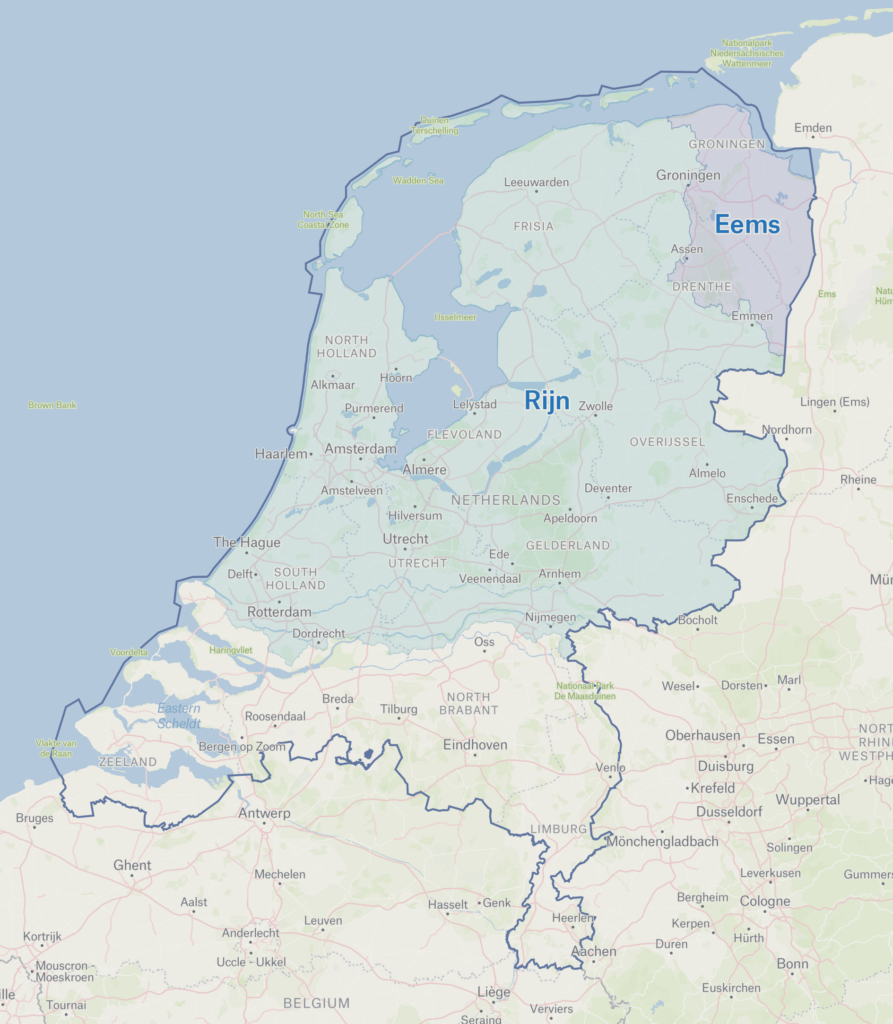
Figure 1. Map of basin boundaries for the Eems and Rijn river catchments.
BEF will consider proposals from any entity with the technical capacity to design, implement, and track and report the progress of voluntary water projects within the Eems and Rijn catchment areas. This includes, but is not limited to:
- Private companies and technology vendors with established implementation capacity
- Public-private partnerships
- Research institutes and knowledge centers
- Agricultural cooperatives and land management organizations
- Nature conservation organizations
- Drinking water companies
- Water authorities (waterschappen)
- Municipal governments and provincial authorities
- Non-Governmental Organizations
- Independent water professionals
BEF welcomes collaborative, interdisciplinary submissions. Projects that bring together a range of experience and expertise are often better able to address complex water related challenges. For example, a university may partner with a private company or local government to develop a project that needs research or technical knowledge to support design and monitoring along with the ability to effectively build and create an on-the-ground solution.
BEF will provide funding through a monetary agreement. Projects must be voluntary and not required under law, permit conditions, or enforcement actions.
| EOI submission period | 28 May – 9 July |
| Webinar | 11 June (15:00 CET) |
| EOI review | 1 July – 31 July |
| Invitation to Submit Technical Proposal | 1 September |
| Technical Proposal submission period | 1 September – 16 October |
| Technical Proposal due | 16 October |
| Technical Proposal Review | 19 October – 13 November |
| Funding decisions | 16 November |
| Contracting | 16 November – 15 February |
How to Respond
The submission period is now closed. If you are interested in submitting a project for review, please send all inquires to bws-eoi@b-e-f.org.
Resources
Organizations interested in responding to this RFI are encouraged to review:
- Volumetric Water Benefit Accounting (VWBA) 2.0 Guidance — World Resources Institute (wri.org)
- Google’s 2026 Water Stewardship Project Portfolio.
- Webinar Slide Deck- June 2026
Frequently Asked Questions
- To see frequently asked questions, click here to enter the FAQ page.
If you have questions, please contact: